publications
(*) denotes equal contribution
2025
-
 NeurIPSImproved Training Technique for Shortcut ModelsIn The Thirty-nine Annual Conference on Neural Information Processing Systems, 2025
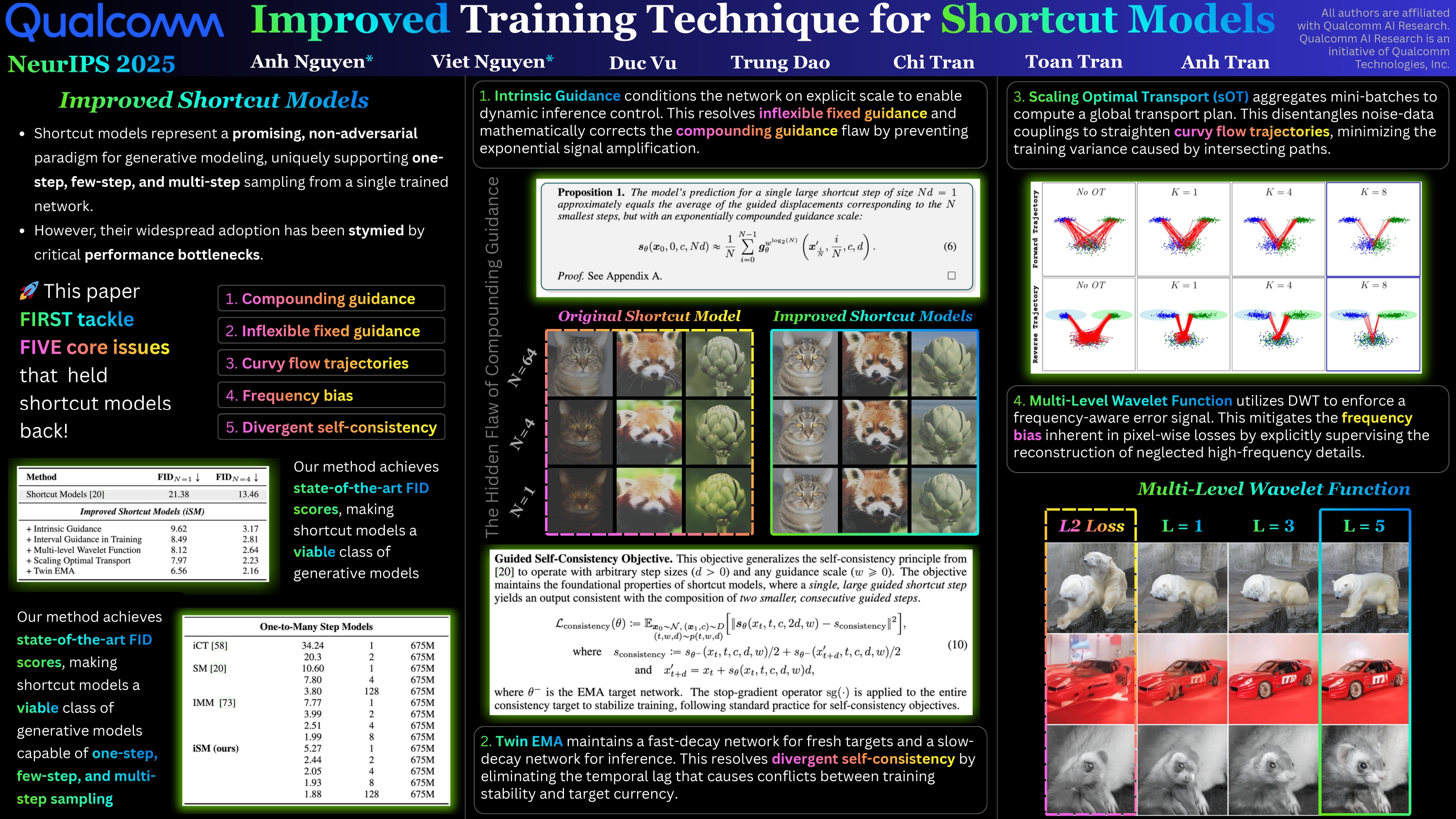
Shortcut models represent a promising, non-adversarial paradigm for generative modeling, uniquely supporting one-step, few-step, and multi-step sampling from a single trained network. However, their widespread adoption has been stymied by critical performance bottlenecks. This paper tackles the five core issues that held shortcut models back: (1) the hidden flaw of compounding guidance, which we are the first to formalize, causing severe image artifacts; (2) inflexible fixed guidance that restricts inference-time control; (3) a pervasive frequency bias driven by a reliance on low-level distances in the direct domain, which biases reconstructions toward low frequencies; (4) divergent self-consistency arising from a conflict with EMA training; and (5) curvy flow trajectories that impede convergence. To address these challenges, we introduce iSM, a unified training framework that systematically resolves each limitation. Our framework is built on four key improvements: Intrinsic Guidance provides explicit, dynamic control over guidance strength, resolving both compounding guidance and inflexibility. A Multi-Level Wavelet Loss mitigates frequency bias to restore high-frequency details. Scaling Optimal Transport (sOT) reduces training variance and learns straighter, more stable generative paths. Finally, a Twin EMA strategy reconciles training stability with self-consistency. Extensive experiments on ImageNet 256 × 256 demonstrate that our approach yields substantial FID improvements over baseline shortcut models across one-step, few-step, and multi-step generation, making shortcut models a viable and competitive class of generative models.
-
 ICCVSupercharged One-step Text-to-Image Diffusion Models with Negative PromptsIn International Conference on Computer Vision, 2025
The escalating demand for real-time image synthesis has driven significant advancements in one-step diffusion models, which inherently offer expedited generation speeds compared to traditional multi-step methods. However, this enhanced efficiency is frequently accompanied by a compromise in the controllability of image attributes. While negative prompting, typically implemented via classifier-free guidance (CFG), has proven effective for fine-grained control in multi-step models, its application to one-step generators remains largely unaddressed. Due to the lack of iterative refinement, as in multi-step diffusion, directly applying CFG to one-step generation leads to blending artifacts and diminished output quality. To fill this gap, we introduce Negative-Away Steer Attention (NASA), an efficient method that integrates negative prompts into one-step diffusion models. NASA operates within the intermediate representation space by leveraging cross-attention mechanisms to suppress undesired visual attributes. This strategy avoids the blending artifacts inherent in output-space guidance and achieves high efficiency, incurring only a minimal 1.89% increase in FLOPs compared to the computational doubling of CFG. Furthermore, NASA can be seamlessly integrated into existing timestep distillation frameworks, enhancing the student’s output quality. Experimental results demonstrate that NASA substantially improves controllability and output quality, achieving an HPSv2 score of 31.21, setting a new state-of-the-art benchmark for one-step diffusion models.
